Smelled my first skunk on the East-West Road Friday morning, just as the snow was beginning.
Does that mean they have woken up from their winter nap and are mating?
Saturday, February 26, 2011


Wednesday, February 23, 2011
2-23 Last Friday the temp spiked briefly up to 58 degrees F. on my thermometer. Those few hours of warmth changed a bird feeder dynamic which had held since Oct.
All winter two Yellow-bellied Sapsuckers had frequented my suet feeders: one juvenile and one adult female. And the juvenile always dominated, driving the adult away from the feeders. The adult only fed if and when the juvenile was either sated or absent. (Perhaps a mother deferring to her young?)
Since last Friday I have seen both sapsuckers foraging on apple and soft maple trees, but not at my feeders. And, this morning, with the temp. at 1 degree above zero I watched the adult female drive the juvenile away from the vicinity of the feeders. Every time the juvenile flew toward a suet feeder and tried to land, the adult dove into its flight path and herded it away.
Apparently the adult female now claims the feeders as part of her nesting territory. And apparently last Friday's warmth triggered that territoriality in her.
The newly dominant adult female will - along with her as yet absent mate - spend many weeks chiseling out a nest cavity in which she will lay her eggs this April.
Establishing a territory is the first step toward the great spring reproductive pulse. For sapsuckers here in my yard that season started last Friday afternoon. I seldom see such tipping points so neatly delineated... although they probably are. Our powers of observation are not geared to such subtleties. John
Tuesday, February 22, 2011
Saturday, February 19, 2011
2-19
Yesterday was warm enough to start a raccoon wandering. It filled its belly with suet and sunflower seed at my bird feeders early last night.
This morning eight turkeys, all bearded, spent half an hour gleaning spilled seed under the feeders. Come warmer weather, competition for hens will make them less tolerant of each other.
Yellow-bellied sapsuckers - regulars at my suet feeders for the last several frigid weeks - foraged on nearby apple and soft maple trees and totally ignored the easy but unnatural pickings at the feeders.
John
Friday, February 18, 2011
Wednesday, February 16, 2011
2-16
This morning a Mourning Dove called persistently from a tree near my yard. It was the first sign of the lengthening days that I'd heard from the doves.
About 40 Cedar Waxwings clustered in the top of an old apple tree - all of them facing the quadrant of the sky where the sun should have been, yet to my senses the overcast blocked any of the sun's warmth from reaching them
And, in the sumac patch near the river, Robins fed on the hard fuzzy seeds.
As a bonus, a Pileated Woodpecker made a few appearances around my neighborhood. I had not seen a pileated in months. I'm sure they were around - as was I - yet we hadn't crossed paths for a while.
John
Sunday, February 6, 2011
Friday, February 4, 2011
Sunday, January 30, 2011


Thursday, January 27, 2011

1-27
Fiercely insectivorous Short-tailed Shrews - which normally eke out and extremely tenuous winter time living under the snow pack - have found easy times in the crawl spaces and stone work under my house. Shelter from the wind, warmer temperatures and prey species can all be found there. Short-tailed shrews eat mostly invertebrates but they also eat larger prey such as other shrews and mice. The saliva of short-tailed shrews is venomous and its bite paralyzes prey species before it eats them. These shrews are very common and they are very fierce; they don't willingly share their territories ... yet they seem to be proliferating under my floors.
That's okay. I don't begrudge them the space, and they keep invertebrate levels in check.
John
Tuesday, January 18, 2011


1-18
This morning during the snow storm this mink was hunting around my house and barn, and even under the barn. It circled the house at least twice, often within 1 to 2 feet. It was into and out of all of my stone walls.
Strangely enough I first spotted it coming down out of one of my big old locust trees. I think it was the first time I ever saw a mink up a tree.
John
Wednesday, January 5, 2011


In Westminster, I came upon a deer that was completely eaten by coyotes, even the bones. First is the area of the kill with 10 feet long of just deer hair, and then the remaining parts which is only the skin (pelt). On the other side of the road, I came upon tracks where 4 coyotes were hunting together.
Sunday, January 2, 2011

1.02.11 The river otter I've been following for 2 years is making his rounds of the local ponds again. Today I followed his track as he bounded and slid from one pond to another about one-half mile away. It followed a mostly-open brook, occasionally dipping in and out, but mainly took the snow-slide option. It terminated at a previously-used dugout, making many muddy tracks in and out. If I'm lucky someday, I'll get to see more than tracks!
1-3
A small flock of robins was feeding with starlings on the morning of 12-31. They were all eating bittersweet and, I assume, broadcasting its seeds
This morning I saw a Carolina wren near the house of one of my neighbors. Carolina wrens are among the southern species that are expanding their range north.
John
Saturday, January 1, 2011

Thursday, December 30, 2010

Saturday, December 18, 2010

Friday, December 17, 2010

12-17
This morning a Yellow-bellied Sapsucker visited my suet feeder. For at least the last 3 winters sapsuckers have overwintered here, although range maps show Conn. to be the northern limit of their winter range.
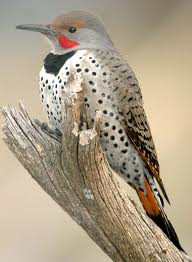
Last winter we also had a Northern Flicker overwinter with us, and frequent our feeders. Range maps show the northern limit of their range to be south of Vermont.
And while these sitings might be the result of the ongoing global warming episode, I suspect that bird feeders were also a factor in the decision of each species to overwinter.
A consistent supply of high energy foods - normally lacking during the winter months - probably made migration an unnecessary risk for them!
John
Subscribe to:
Posts (Atom)
