4-11
There was a Pine Warbler in my yard today. True to their name these warblers nest in dry pine woods.
Chipping Sparrows also put in an appearance. Chipping sparrows line their nests with hair so after my spring haircut I scatter the clippings on the lawn. In the fall I've found sparrow nests with absolutely gorgeous silvery linings.
And, high overhead, a Great Blue Heron was on the move. Great blues nest in communal heronries and often have to travel many miles from the nest site to find food, but right now I expect that they're just intent on finding ice free water.
John
Friday, April 11, 2014


Tuesday, April 8, 2014
4-8
4-8
This afternoon one of the few breaks of sunshine - an Osprey sailed over, the first I've seen this year.
John
This afternoon one of the few breaks of sunshine - an Osprey sailed over, the first I've seen this year.
John
Spring at Black Mountain

Also, remember, ticks are probably out now.
Sunday, April 6, 2014
4-6
4-6
At least one Kingfisher is back on the West River. Unfortunately it wouldn't pose for a picture.
Woolly Bears are on the move. Wooly Bears are the larvae of Isabella Tiger Moths. They overwinter as caterpillars and pupate in the spring.
A pair of Mallards posed nicely for a picture. Mallards are dead common and can be seen every month of the year, but the drakes are extra resplendent right now.
And, in sheltered, warm micro-climates a few Hepatica are turning their flowers to the sun. In a week or two there will be hundreds where today there were only a scattered few.
John
At least one Kingfisher is back on the West River. Unfortunately it wouldn't pose for a picture.
Woolly Bears are on the move. Wooly Bears are the larvae of Isabella Tiger Moths. They overwinter as caterpillars and pupate in the spring.
A pair of Mallards posed nicely for a picture. Mallards are dead common and can be seen every month of the year, but the drakes are extra resplendent right now.
And, in sheltered, warm micro-climates a few Hepatica are turning their flowers to the sun. In a week or two there will be hundreds where today there were only a scattered few.
John
 |
| Hepatica |
 |
| Hepatica |
 |
| A pair of Mallards |
 |
| Woolly Bear |
Friday, April 4, 2014
4-4
4-4
Tree Swallows are back. Last year my earliest sighting was on 4-1, making them three days later this year.
However, last year my earliest phoebe sighting was on 4-4. This year they were back on 4-2, tow days earlier.
Apparently this year cool March weather was not much of a deterrent to these insectivores.
John

Tree Swallows are back. Last year my earliest sighting was on 4-1, making them three days later this year.
However, last year my earliest phoebe sighting was on 4-4. This year they were back on 4-2, tow days earlier.
Apparently this year cool March weather was not much of a deterrent to these insectivores.
John
Thursday, April 3, 2014
4-3
4-3
After an uneventful morning walk I came home to find a Yellow-rumped Warbler twittering softly and flitting from branch to branch in the maple behind my barn. Yellow-rumps are hardy. I've seen them in late October, and some winter along the New England coast subsisting on berries in the absence of insects.
And a Mourning Cloak butterfly was flying. Mourning cloaks overwinter as adults and , therefore, are among the first butterflies seen in the spring.
John

After an uneventful morning walk I came home to find a Yellow-rumped Warbler twittering softly and flitting from branch to branch in the maple behind my barn. Yellow-rumps are hardy. I've seen them in late October, and some winter along the New England coast subsisting on berries in the absence of insects.
And a Mourning Cloak butterfly was flying. Mourning cloaks overwinter as adults and , therefore, are among the first butterflies seen in the spring.
John
Wednesday, April 2, 2014
4-2
4-2
Phoebes are back. Yesterday - despite a diligent search - I could find none. Today along the West River there were at least ten. And there was a fox sparrow under my feeders this morning.
In the afternoon, raptors were on the move: 5 red-shouldered hawks, 1 Cooper's, 7 red-tails, 22 turkey vultures, 3 sharp-shinned, 1 northern harrier and 1 bald eagle went over in 2 hours. Also 13 gulls and a raven.
Eight skeins of Canada geese totaling about 300 birds went over while I was doing yard clean -up.
Spring is on the move.
John
Phoebes are back. Yesterday - despite a diligent search - I could find none. Today along the West River there were at least ten. And there was a fox sparrow under my feeders this morning.
In the afternoon, raptors were on the move: 5 red-shouldered hawks, 1 Cooper's, 7 red-tails, 22 turkey vultures, 3 sharp-shinned, 1 northern harrier and 1 bald eagle went over in 2 hours. Also 13 gulls and a raven.
Eight skeins of Canada geese totaling about 300 birds went over while I was doing yard clean -up.
Spring is on the move.
John
 |
| Phoebe |
Tuesday, April 1, 2014
4-1
4-1
Pussywillows that started opening a month ago are now fulfilling their destiny. These are the willow flowers. Some will develop golden stamens, others greenish pistils.
On sunny lawns, crocuses and snow drops are flowering where a day or two ago there was ice and snow.
And in snowy ditches Colt's foot is turning its face to the sun. This dandelion look-alike can be identified by its scaly stem and by its lack of leaves when flowering. Colt's foot is an alien and it's a bit invasive, but it sure is a welcome sign of what's to come.
John


Pussywillows that started opening a month ago are now fulfilling their destiny. These are the willow flowers. Some will develop golden stamens, others greenish pistils.
On sunny lawns, crocuses and snow drops are flowering where a day or two ago there was ice and snow.
And in snowy ditches Colt's foot is turning its face to the sun. This dandelion look-alike can be identified by its scaly stem and by its lack of leaves when flowering. Colt's foot is an alien and it's a bit invasive, but it sure is a welcome sign of what's to come.
John
Sunday, March 30, 2014
3-30
3-30
There is at least one Woodcock back in my neighborhood, although it is not doing much performing yet.
John
There is at least one Woodcock back in my neighborhood, although it is not doing much performing yet.
John
Tuesday, March 25, 2014
3-25
3-25
Today's new avian arrivals are Brown-headed Cowbirds. Cowbirds are brood parasites - they lay their eggs in the nests of other birds - and are often reviled by bird lovers.
However, right now any and all signs of spring are welcome, including cowbirds.
Red-tailed hawks in my neighborhood are sitting on eggs and crows are adding twigs to their nests.
Spring is creeping north!
John
Today's new avian arrivals are Brown-headed Cowbirds. Cowbirds are brood parasites - they lay their eggs in the nests of other birds - and are often reviled by bird lovers.
However, right now any and all signs of spring are welcome, including cowbirds.
Red-tailed hawks in my neighborhood are sitting on eggs and crows are adding twigs to their nests.
Spring is creeping north!
John
Sunday, March 23, 2014

Saturday, March 22, 2014
3-22
3-22
Yesterday a Common Grackle joined the Red-winged Blackbirds at my feeders.
A Sharp-shinned Hawk also returned, much to the consternation of the smaller birds.
Some years a Sharpie will stay all winter hunting passerines at my feeders. This year I had not seen one for three months!
This morning a Northern Flicker moved through with a flock of 30 - 40 robins that stopped in my yard. Flickers are ant specialists so I don't know what this one was finding to eat although I have in the past seen them pick up suet crumbs under feeders.
John
Yesterday a Common Grackle joined the Red-winged Blackbirds at my feeders.
A Sharp-shinned Hawk also returned, much to the consternation of the smaller birds.
Some years a Sharpie will stay all winter hunting passerines at my feeders. This year I had not seen one for three months!
This morning a Northern Flicker moved through with a flock of 30 - 40 robins that stopped in my yard. Flickers are ant specialists so I don't know what this one was finding to eat although I have in the past seen them pick up suet crumbs under feeders.
John
Tuesday, March 18, 2014
3-18
3-18
A few Skunk Cabbage are putting up new growth. The mottled spathe (pictured) shelters the spadix which is covered with tiny yellow flowers. These are the first wildflowers of the year!
John

A few Skunk Cabbage are putting up new growth. The mottled spathe (pictured) shelters the spadix which is covered with tiny yellow flowers. These are the first wildflowers of the year!
John
Saturday, March 15, 2014
3-15
3-15
Down along the West River, Song Sparrows are dividing the thickets into territories and singing in defense of their claim.
Tom Turkeys are strutting their stuff. The hens are not yet receptive. All the show is for other toms. They're sorting out the dominance hierarchy.
And two or three very nervous Red-winged Blackbirds were hanging around my feeders this morning!
John

Down along the West River, Song Sparrows are dividing the thickets into territories and singing in defense of their claim.
Tom Turkeys are strutting their stuff. The hens are not yet receptive. All the show is for other toms. They're sorting out the dominance hierarchy.
And two or three very nervous Red-winged Blackbirds were hanging around my feeders this morning!
John
Tuesday, March 11, 2014
3-11
3-11
The first Turkey Vulture that I've seen this year was working its way up the West River valley today! It won't go hungry. The winter was hard on the deer herd … and it may not be over quite yet.
John

The first Turkey Vulture that I've seen this year was working its way up the West River valley today! It won't go hungry. The winter was hard on the deer herd … and it may not be over quite yet.
John
Monday, March 10, 2014
3-10
3-10
Although recent nights have not seemed like ideal moth weather, this Three-spotted Sallow (Eupsilia tristigmata) was at least briefly airborn. According to the field guide, three-spotted sallows often fly "on warm nights during winter." I found this one road-killed along Route 30.
John

Although recent nights have not seemed like ideal moth weather, this Three-spotted Sallow (Eupsilia tristigmata) was at least briefly airborn. According to the field guide, three-spotted sallows often fly "on warm nights during winter." I found this one road-killed along Route 30.
John
Saturday, March 8, 2014
3-8
3-8
A gray squirrel "tapped" this maple limb. Sun and wind do the evaporating. The squirrel will return periodically to savor the sugar… along with bits of bark, lichen and a dusting of road grit!
John

A gray squirrel "tapped" this maple limb. Sun and wind do the evaporating. The squirrel will return periodically to savor the sugar… along with bits of bark, lichen and a dusting of road grit!
John
Friday, March 7, 2014
3-7
3-7
As I had not seen either of the local raven pair at my compost pile for the last week or ten days I assumed that they were nesting. This morning I confirmed my suspicions; one raven was sitting on the nest, the other lurked quietly in the area.
And in a stagnant West River backwater algae has turned the water thickly green! The food chain is rebuilding, even as snow and cold linger.
John

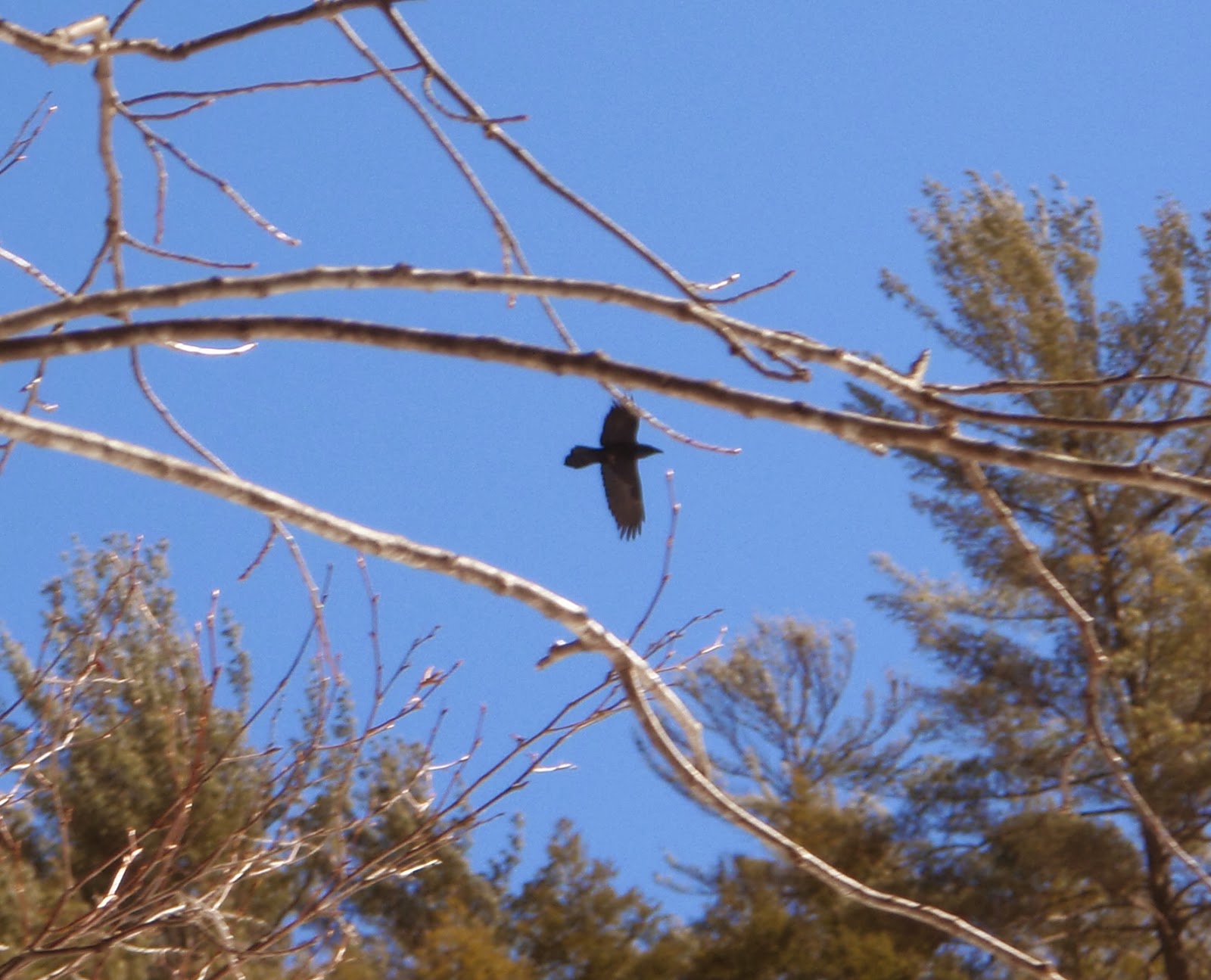
As I had not seen either of the local raven pair at my compost pile for the last week or ten days I assumed that they were nesting. This morning I confirmed my suspicions; one raven was sitting on the nest, the other lurked quietly in the area.
And in a stagnant West River backwater algae has turned the water thickly green! The food chain is rebuilding, even as snow and cold linger.
John
Monday, March 3, 2014
3-3
3-3
This recently returned Hermit Thrush was hunting for invertebrates in the leaves along a nearby brook. Like most thrushes, Hermits also eat a lot of berries.
They are also very hardy. I've seen an occasional fall hanger-on as late as New Year's day!
John

This recently returned Hermit Thrush was hunting for invertebrates in the leaves along a nearby brook. Like most thrushes, Hermits also eat a lot of berries.
They are also very hardy. I've seen an occasional fall hanger-on as late as New Year's day!
John
Sunday, March 2, 2014
3-2
3-2
This chipmunk had a comfortable perch about 8 feet up in a rotten beech snag.
Dozens of robins and a few bluebirds were feeding today on both the ice and along the shores of the West River. Perhaps on stoneflies?
John

This chipmunk had a comfortable perch about 8 feet up in a rotten beech snag.
Dozens of robins and a few bluebirds were feeding today on both the ice and along the shores of the West River. Perhaps on stoneflies?
John
Subscribe to:
Posts (Atom)
