Welcome

To all those interested in the natural world. Please add your sightings.

In the woods we return to reason and faith-Emerson

Best-Lynn

Saturday, April 19, 2014

4-19

4-19
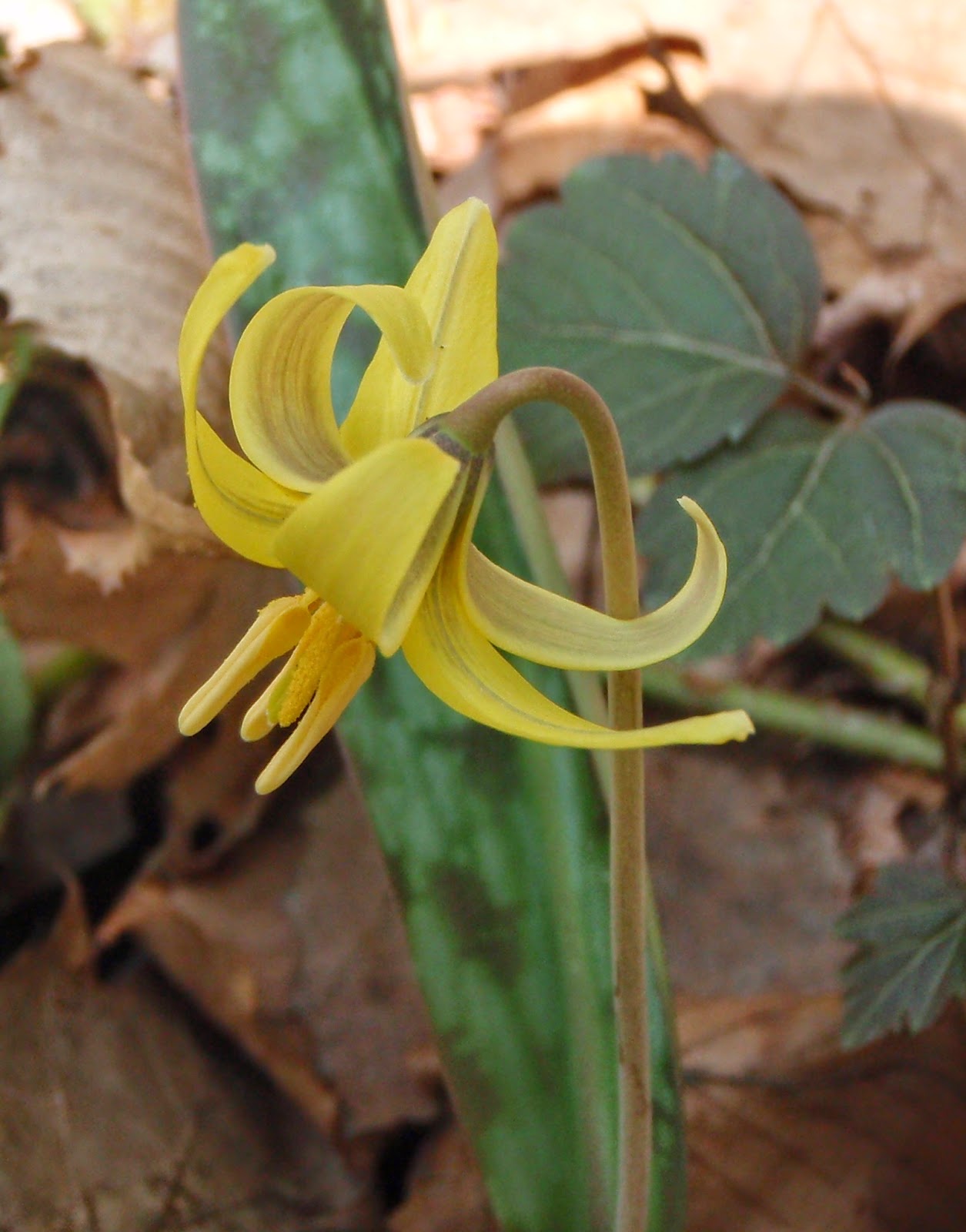
Dutchman's Breeches and Trout Lilies are in flower … in Brattleboro. A sedge - Carex pennsylvanica - while not very showy, is also flowering. The sedge is common in oak woods and flowers before trees leaf out. l
Along the West River a Spotted Sandpiper was checking out exposed cobbles and sandbars.
And a rather destructive caterpillar was tunneling through a trillium as I came by. Although it posed nicely I was unable to identify the species.
John
Dutchman's Breeches

sedge

Trout Lily

Caterpillar on Trillium bud

Friday, April 18, 2014

4-18

4-18
At the beaver pond on Black Mountain a goose kept a low profile hoping to go unnoticed. She was motionless and silent even when I was within twenty feet.
And, while removing house shutters in preparation for painting, I found a smallish bat, just over 3 inches nose to tail. I was unable to determine the species … all of the bats in my field guide were snarling. This bat was sleeping peacefully. Later, when the day warmed, it moved to a better location.
John


Thursday, April 17, 2014

4-17

4-17
This morning a Palm Warbler - identifiable by its rusty cap, bright yellow undertail coverts and its tail wagging - flitted through the brush ahead of me.
A lone Wild Strawberry blossom graced a sunny grassy area.
And Wake Robin (AKA Purple Trillium) was flowering in a wet sunny woodland location.
John
Wild Strawberry

Wake Robin (Purple Trillium)

Wednesday, April 16, 2014

4-16

4-16
Not a good day for wildflowers but I went out to look anyway. None were evident, but, atop Black Mountain there was a garter snake! It was in a sunny pocket, sheltered from the wind where, despite snow in the woods, temperatures were decidedly springish.
John

Tuesday, April 15, 2014

4-15

4-15
Poplar catkins are open. Red Maple flowers are close behind. American Toads are out of hibernation … and falling victim to traffic.
Two well-established garden escapes are starting to flower: Myrtle and Daphne.
John
Myrtle

Daphne

Monday, April 14, 2014

4-14

4-14
This morning a crow in my yard was begging to be fed exactly as a juvenile would beg its parents. The crow was a female and the behavior was pre-nesting pair bonding. She wants him to prove his ability to provide. Later I watched one crow present a wood frog to another. Hopefully, she was impressed.
Green Six-spotted Tiger Beetles are out and about. Tiger beetles are predators and feed on many insects that we consider pests.
And Spring Azures are flying. These bright blue butterflies are common at this time of year. In a few months there will be a second brood. Taxonomists think that there may be as many as nine species lumped under the name "Spring Azure."
There are still things to be learned 'out there'!
John

Sunday, April 13, 2014

4-13

4-13
This morning White-throated sparrows seemed determined to be noticed. Every thicket had one - or several!
Over the Connecticut River at Dummerston Landing hundreds of swallows - mostly tree swallows - dove, darted and dipped in the cool damp morning air.
And at the Retreat Meadows, 35 or 40 Double-crested Cormorants perched drying their feathers. Cormorants dive for fish but must dry off afterward. They have a layer of waterproof feathers near their skin to protect them from the cold water, but their outer feathers are wettable. Wet feathers make it easier for the bird to dive, but necessitate drying.
John

Saturday, April 12, 2014

4-12

4-12
 I walked 5 miles this morning looking for Bloodroot … and found Saxifrage. When I got home Bloodroot was in flower in my kitchen garden. So it goes.
John
Saxifrage

Bloodroot

Friday, April 11, 2014

4-11

4-11
It's happening!


4-11

4-11
There was a Pine Warbler in my yard today. True to their name these warblers nest in dry pine woods.
Chipping Sparrows also put in an appearance. Chipping sparrows line their nests with hair so after my spring haircut I scatter the clippings on the lawn. In the fall I've found sparrow nests with absolutely gorgeous silvery linings.
And, high overhead, a Great Blue Heron was on the move. Great blues nest in communal heronries and often have to travel many miles from the nest site to find food, but right now I expect that they're just intent on finding ice free water.
John

Tuesday, April 8, 2014

4-8

4-8
This afternoon one of the few breaks of sunshine - an Osprey sailed over, the first I've seen this year.
John

Spring at Black Mountain

On Black Mountain, a spotted wintergreen revealed itself after the snow had melted.
Also, remember, ticks are probably out now.

Sunday, April 6, 2014

4-6

4-6
At least one Kingfisher is back on the West River. Unfortunately it wouldn't pose for a picture.
Woolly Bears are on the move. Wooly Bears are the larvae of Isabella Tiger Moths. They overwinter as caterpillars and pupate in the spring.
A pair of Mallards posed nicely for a picture. Mallards are dead common and can be seen every month of the year, but the drakes are extra resplendent right now.
And, in sheltered, warm micro-climates a few Hepatica are turning their flowers to the sun. In a week or two there will be hundreds where today there were only a scattered few.
John
Hepatica

Hepatica

A pair of Mallards

Woolly Bear

Friday, April 4, 2014

4-4

4-4
Tree Swallows are back. Last year my earliest sighting was on 4-1, making them three days later this year.
However, last year my earliest phoebe sighting was on 4-4. This year they were back on 4-2, tow days earlier.
Apparently this year cool March weather was not much of a deterrent to these insectivores.
John

Thursday, April 3, 2014

4-3

4-3
After an uneventful morning walk I came home to find a Yellow-rumped Warbler twittering softly and flitting from branch to branch in the maple behind my barn. Yellow-rumps are hardy. I've seen them in late October, and some winter along the New England coast subsisting on berries in the absence of insects.
And a Mourning Cloak butterfly was flying. Mourning cloaks overwinter as adults and , therefore, are among the first butterflies seen in the spring.
John

Wednesday, April 2, 2014

4-2

4-2
Phoebes are back. Yesterday - despite a diligent search - I could find none. Today along the West River there were at least ten. And there was a fox sparrow under my feeders this morning.
In the afternoon, raptors were on the move: 5 red-shouldered hawks, 1 Cooper's, 7 red-tails, 22 turkey vultures, 3 sharp-shinned, 1 northern harrier and 1 bald eagle went over in 2 hours. Also 13 gulls and a raven.
Eight skeins of Canada geese totaling about 300 birds went over while I was doing yard clean -up.
Spring is on the move.
John
Phoebe

Tuesday, April 1, 2014

4-1

4-1
Pussywillows that started opening a month ago are now fulfilling their destiny. These are the willow flowers. Some will develop golden stamens, others greenish pistils.
On sunny lawns, crocuses and snow drops are flowering where a day or two ago there was ice and snow.
And in snowy ditches Colt's foot is  turning its face to the sun. This dandelion look-alike can be identified by its scaly stem and by its lack of leaves when flowering. Colt's foot is an alien and it's a bit invasive, but it sure is a welcome sign of what's to come.
John


Sunday, March 30, 2014

3-30

3-30
There is at least one Woodcock back in my neighborhood, although it is not doing much performing yet.
John

Tuesday, March 25, 2014

3-25

3-25
Today's new avian arrivals are Brown-headed Cowbirds. Cowbirds are brood parasites - they lay their eggs in the nests of other birds - and are often reviled by bird lovers.
However, right now any and all signs of spring are welcome, including cowbirds.
Red-tailed hawks in my neighborhood are sitting on eggs and crows are adding twigs to their nests.
Spring is creeping north!
John

Sunday, March 23, 2014

It's coming.  It's coming.  The bears are awake.  Saw these prints yesterday.

Saturday, March 22, 2014

3-22

3-22
Yesterday a Common Grackle joined the Red-winged Blackbirds at my feeders.
A Sharp-shinned Hawk also returned, much to the consternation of the smaller birds.
Some years a Sharpie will stay all winter hunting passerines at my feeders. This year I had not seen one for three months!
This morning a Northern Flicker moved through with a flock of 30 - 40 robins that stopped in my yard. Flickers are ant specialists so I don't know what this one was finding to eat although I have in the past seen them pick up suet crumbs under feeders.
John

Tuesday, March 18, 2014

3-18

3-18
A few Skunk Cabbage are putting up new growth. The mottled spathe (pictured) shelters the spadix which is covered with tiny yellow flowers. These are the first wildflowers of the year!
John

Saturday, March 15, 2014

3-15

3-15
Down along the West River, Song Sparrows are dividing the thickets into territories and singing in defense of their claim.
Tom Turkeys are strutting their stuff. The hens are not yet receptive. All the show is for other toms. They're sorting out the dominance hierarchy.
And two or three very nervous Red-winged Blackbirds were hanging around my feeders this morning!
John

Tuesday, March 11, 2014

3-11

3-11
The first Turkey Vulture that I've seen this year was working its way up the West River valley today! It won't go hungry. The winter was hard on the deer herd … and it may not be over quite yet.
John

Monday, March 10, 2014

3-10

3-10
Although recent nights have not seemed like ideal moth weather, this Three-spotted Sallow (Eupsilia tristigmata) was at least briefly airborn. According to the field guide, three-spotted sallows often fly "on warm nights during winter." I found this one road-killed along Route 30.
John

Saturday, March 8, 2014

3-8

3-8
A gray squirrel "tapped" this maple limb. Sun and wind do the evaporating. The squirrel will return periodically to savor the sugar… along with bits of bark, lichen and a dusting of road grit!
John

Friday, March 7, 2014

3-7

3-7
As I had not seen either of the local raven pair at my compost pile for the last week or ten days I assumed that they were nesting. This morning I confirmed my suspicions; one raven was sitting on the nest, the other lurked quietly in the area.
And in a stagnant West River backwater algae has turned the water thickly green! The food chain is rebuilding, even as snow and cold linger.
John

Monday, March 3, 2014

3-3

3-3
This recently returned Hermit Thrush was hunting for invertebrates in the leaves along a nearby brook. Like most thrushes, Hermits also eat a lot of berries.
They are also very hardy. I've seen an occasional fall hanger-on as late as New Year's day!
John

Sunday, March 2, 2014

3-2

3-2
This chipmunk had a comfortable perch about 8 feet up in a rotten beech snag.
Dozens of robins and a few bluebirds were feeding today on both the ice and along the shores of the West River. Perhaps on stoneflies?
John

Sunday, February 23, 2014

2-23

2-23
Snow Fleas are swarming atop the snow. Normally found in the leaf litter, snow fleas are active on warm winter days and, in early spring, when they mate. They look like dark, animated pepper specks.
Along the West River, Stoneflies are starting to emerge. Aquatic for most of their lives, stoneflies crawl out of the water, molt and live long enough to mate. Most do not eat as adults. They are very poor fliers and can be seen crawling atop the snow.
John

Sunday, February 16, 2014

Patterns in Nature

The trees never stop providing beauty.  What could this be?

Monday, February 10, 2014

Snow Buntings

I have tried and tried to sneak up on these 10 snow buntings who have been visiting my backyard. You'll just have to take my word for it!

Sunday, February 9, 2014

expect the unexpected

We know everything wonderful grows in Dummerston, but I didn't expect this to be growing from sphagnum moss.

Wednesday, February 5, 2014

new snow

The slate has been cleared with the new wonderful snow.  Almost cleared.  Here are some old tracks with my foot in the foreground.  The tracks line up perfectly.  This gray squirrel was the last to move after the snow began.

Friday, January 31, 2014

1-31

1-31
Today a group of male Hooded Mergansers dodged ice floes in the West River.
A flock of Cedar Wax-wings, robins, starlings and English Sparrows fed on apples and bittersweet in West Dummerston village.
And yesterday an adult Bald Eagle was cruising at tree top height just north of the covered bridge.
John

Saturday, January 18, 2014

1-18

1-18
If you have hemlock trees, now is the time to survey for Adelgids.
Hemlock Wooly Adelgid is most visible in mid and late winter. This infestation was along Camp Arden Road on a tree that I've checked frequently over the past few winters. This year adelgids are for the first time both present and easily visible.
John

Friday, January 17, 2014

1-17

1-17
For the first time in the 20 plus years that I've been offering suet to birds, Pileated woodpeckers are coming to feed!
As you can see, suet feeders, designed for downy and hairy woodpeckers, are inadequate for these birds.
Pileateds are carpenter ant and borer grub specialists and can demolish an infested tree while excavating for food.
They also eat a lot of berries and fruits including grapes and bittersweet berries.
John

Wednesday, January 15, 2014

1-15

1-15
Today along Camp Arden Road this Chipmunk surveyed its territory … and enjoyed a bit of sun!
And along the north border of my field, on the dry, sun-warmed leaves, a Grouse Locust also took advantage of the day.
John