Welcome

To all those interested in the natural world. Please add your sightings.

In the woods we return to reason and faith-Emerson

Best-Lynn

Wednesday, February 20, 2013

2-20 This morning I found a cricket atop the snow, frozen. As it was wingless I knew that it was not an adult. Crickets moult through as many as 8 -10 wingless instars before reaching winged maturity.
However, there are many species of "ground" and "field" crickets and precise identification requires a lot of esoteric knowledge. I didn't expect to be able to precisely identify this specimen, but it seemed determined to be properly named: as soon as I brought it into the house it revived! Many crickets at this latitude overwinter only as eggs. Adults and nymphs are killed by cold. Overwintering as a nymph is noteworthy. Freezing solid and then reviving is both a good trick and a possible clue.
It seems that there are 2 distinct species of the common black field cricket. One species overwinters as eggs in the soil. That species - responsible for the late summer chorus - is active in summer and fall. The other possibly overlooked species overwinters in a nymphal stage and is active in the spring and early summer. These two cricket species are physically identical! They behave identically! They sing identically! Only the appearance separates the two species.
So, my guess is that the frozen cricket nymph I found on the snow is the spring species of common field cricket. It looks like a black field cricket and it survived freezing as a nymph. So …
Now the only question I have is how did it end up atop the late Feb. snow pack?
John

Friday, February 15, 2013


2-15
The 8 inch diameter hemlock this porcupine was feeding on along Camp Arden Rd had just 3 branches left. In the porky's world the tree is winter food and winter is not yet over.
Just down the road in the direct sunlight Pussy Willows sensed that winter is over - or nearly so - and they poised themselves for the new season to come.
John

Wednesday, February 13, 2013

2-13
Late this morning a subadult Bald Eagle worked north up the West River valley.
John

Tuesday, February 12, 2013

2-12
This morning there was a song sparrow huddled in the brush along the West River.
Although song sparrows are listed as year round residents of the area, I never see them until late winter or early spring.
Song sparrows are early to return to this neighborhood, early to claim territories and early to sing in defense of that territory. I see them among the first signs of spring.
John

Saturday, February 9, 2013


Nineteen turkeys visit our Dwarf Cherry trees as the blizzard of February 2013 is just starting. Betsy

Friday, February 8, 2013

2-8
Early today, as 35 or 40 Mourning Doves took full advantage of the bird sees I'd scattered in my driveway, one overly frisky male dove advertised his availability from the treetops with his mournful and repetitive cooing.
Today's weather may say winter to us, but at least one dove is already anticipating spring … although his advertising elicited no noticeable response.
John

Wednesday, February 6, 2013


2-6
While looking for - and finding - Hemlock Woolly Adelgid along Quarry Road I spotted this adult Bald Eagle cruising north over the West River.
John

Sunday, February 3, 2013

2-3
This morning before daylight a raccoon cleaned up under my bird feeders. A skunk also came by, unseen but not unscented!
John


Thursday, January 24, 2013

mystery in East Dummerston

Tracking in my woods yesterday I saw in the distance all these tracks.  I approached and I found this animal dead and partially eaten.  I wasn't sure it was a wild animal or a cat until I counted it's toes and there were five on each foot, so I knew it wasn't a cat, but a raccoon.  The process of figuring what is going on is the name of the game.


Wednesday, January 23, 2013

Utah Eurasian Collared-Dove


1.23.13     Sub-freezing temperatures are starting to feel normal, and today's high of 26 degrees seems almost spring-like!   We've been observing "some kind of dove" for a while, but today it stayed under the feeder long enough to get some really definitive views.  The Eurasian Collared-Dove (Streptopelia decaocto), according to David Sibley, was introduced to the Bahamas in 1974 from Europe and Asia and has expanded its range northward and westward.  It apparently is a hardy bird, having survived recent temperatures. 
         The Short-eared Owl that I reported on a few weeks ago has continued to visit its rock ledge shelter on the northeast porch.  Dissection of two pellets revealed lots of mouse hair, bits of dried vegetative matter, and one object (at 30x magnification) that looked a whole lot like a tick.  I swept up after him this morning; the one pellet crumbled to dust and didn't allow any close inspection.  However, the quantity of scat would indicate that it is finding plenty to eat!

Tuesday, January 22, 2013

1-22
Wintercreeper (Euonymus fortunei) lends a bit of green to the winter woods. Wintercreeper is an introduced species; an aggressive escape. There are many cultivated varieties, at least two of which grow wild in my neighborhood. Left to its own devices this species will climb and eventually shade out and kill the tree that supports it!
John

Thursday, January 17, 2013

1-17
This slender green spider (probably one of the orb weavers) was stiff and cold when I found it atop the snow. However, in the warmth of my kitchen it quickly revived!
John

Wednesday, January 16, 2013

New tree species found in Dummerston

 This is a leaf from chestnut oak found in East Dummerston. As far as John Anderson knows, this is the first sighting in Dummerston.  It would be unusual for this species to be so far North.  The tree I found it on is probably at least 50 years old.  I will check with other experts to confirm my finding.

Monday, January 14, 2013

Utah 1.14.13

Utah weather contrasts dramatically with Dummerston's today.  John writes about 50 degree temperatures; in Morgan, UT it was -18 this morning, with a high of +10.   The Mountain Cottontail that lives in this neighborhood, finds shelter in gaps in the stone walls and  bounds around the house near the foundation where the snow is most shallow.  On the past few mornings and evenings just at dusk, it feeds underneath the bird feeders.   This little gray rabbit with rather short ears is the smallest of cottontails; its tail is gray above with white underneath. 


The Magpie often stops by just at sunrise; the American Kestrel looks at least double its summer size in its downy parka with head barely sticking out as it assumes his watch atop the leader of a Blue Spruce.  Ice is closing in on a lone Mallard that still paddles at the inlet of the local waterhole where Mule deer can be seen before the sun appears.   Recently, we watched a young Mule deer walk directly to the house where it lay down touching the foundation.  By looking closely, we could see the  long "mule" ears at the bottom of the window. 
1-14
That rare January combination of temperatures near 50 degrees F and dry ground on some south facing exposures made it possible to find a few grouse locusts (Family tetrigidae) today.
This one was basking on dead leaves along the wood's edge in my field, and was warm enough to make several 12 to 18 inch leaps before pausing as if posing for this picture.
Many insects and spiders were moving down in among the leaves and pine needles where temperatures were perhaps as much as 20 degrees higher than the 50 degrees registered in the air.
John

Sunday, January 13, 2013

1-13
This worm was crawling atop the snow in my backyard today. (Perhaps to escape the water saturated ground?)
Usually I let nature take its course but - feeling omnipotent - I moved this hapless critter to a patch of bare, thawed, less saturated ground.
A worm atop the snow probably has little to no chance of escaping the notice of hungry birds, or of reaching safe unsaturated ground, but even a slight chance of survival must have seemed better than the alternatives. Snow must be a horribly hostile environment for a worm to choose…
John


Friday, January 11, 2013

1-11
Despite water which might be best described as "liquid ice" this female Common Merganser fished contentedly in the West River today.
Meanwhile flocks of robins and bluebirds ate winterberries (Black alder fruit) along the shore.
black alder (Ilex verticillate) is a member of the Holly family and its beautiful scarlet-red berries remain on the stem long after the leaves fall.
John

Sunday, December 23, 2012

Utah Gray Partridges in a Spruce tree


Greetings all!   No pear tree, but. . .  Seen through a cloud of thick gray fog this morning, 10 Gray Partridges were huddled underneath a Blue Spruce tree in the back yard.  As the fog lifted, they ventured out to feed in the snow.  The lone male has large dark patches on his breast; the females' breasts are gray and white.  The rusty heads and barred sides are similar in both sexes.  This is probably the same family that I observed in the area over the summer; their numbers are reduced from 13, but I never observed a male with them.  Gray Partridges were imported from Europe; I've heard them referred to as "Hungarian Partridges."   The bird feeders are now up, but we've observed only two goldfinches taking advantage of the free provisions.

Saturday, December 22, 2012


12-22
A few Myrtle blossoms still grace the corner of Hague Rd. Myrtle is a hardy garden escape, an alien, yet any flowers are welcome now!
John

Friday, December 21, 2012


12-21
At dawn many winter cutworms - and the occasional earthworm - were crawling atop the snow!
John


Tuesday, December 4, 2012

12-4
Cave Crickets (Ceuthophilus maculatus) survive the winter in our spring house.
John

Monday, December 3, 2012

12-3
Two common lichens, British Soldiers (Cladonia cristatella) and Pyxie Cups (Cladonia pyxidata) add a touch of color to the fall landscape.
John

Saturday, December 1, 2012


12-1
At least 4 Bluebirds have been foraging under my bird feeders. They appear to be gleaning crumbs of suet dropped by other birds. They may also be eating some millet. And they are learning to go directly to the hanging feeders for food.
John

Monday, November 26, 2012

11-26
In sheltered spots a few Witch Hazel blossoms can still be found. These fertilized flowers will not start to form seed pods until next spring and the seeds will mature late next summer. When the mature seed pods eventually dry out, tension builds within the pod until it pops open explosively, casting seeds away from the parent plant.
John

Sunday, November 25, 2012

11-25

The dried heads of Thimbleweed (Anemone virginiana) stand ready to spread seeds on the November wind. John

Thursday, November 15, 2012

11-15
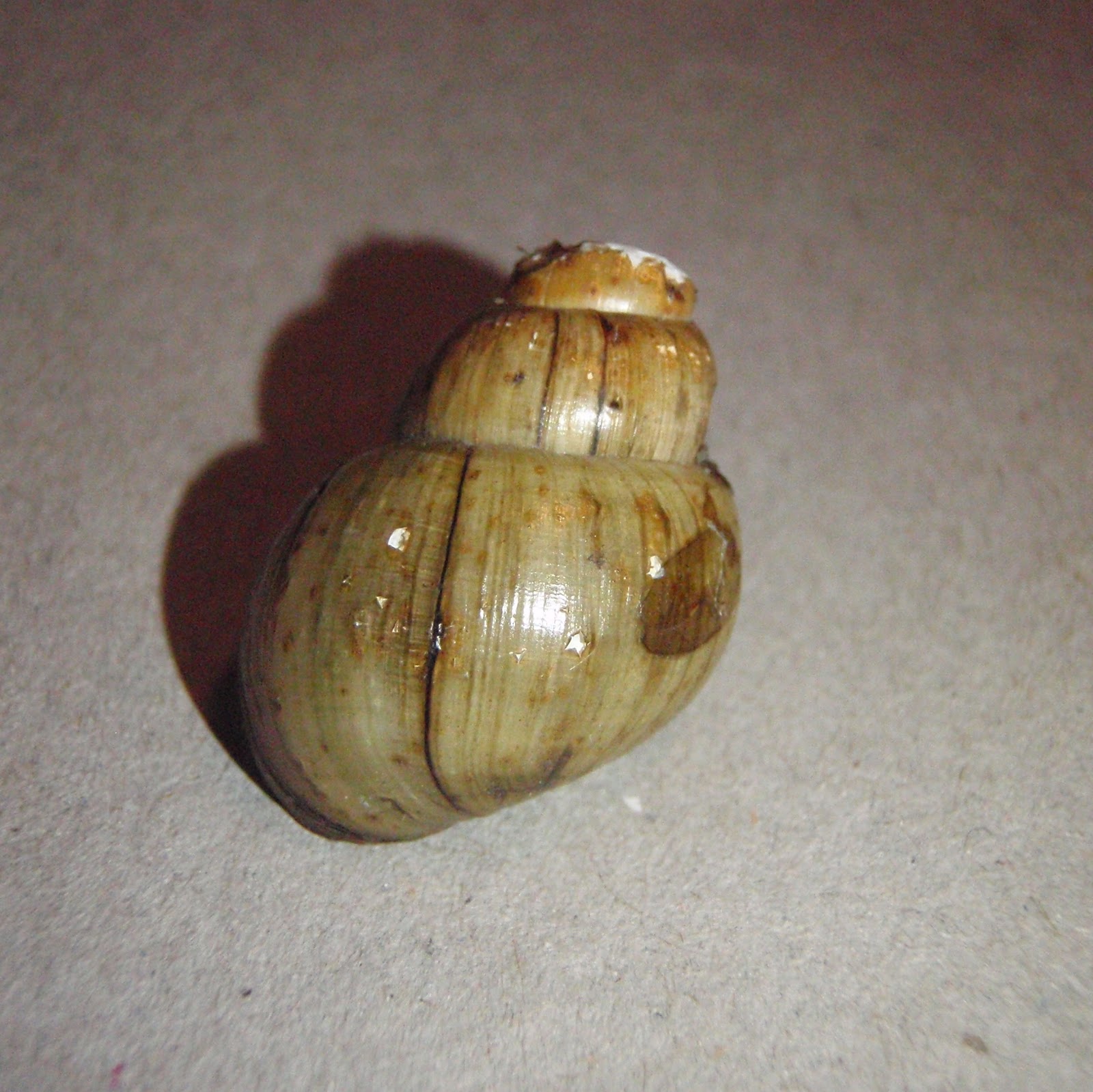
Today during my ramble I picked up this decapitated but nevertheless rather pretty snail shell along the shore of a pond.
Perhaps a Chinese Mystery Snail (?) so called because the species gives birth to live young rather than laying eggs in "normal" snail fashion.
Mystery snails were imported into the US by the aquarium industry and are quickly spreading nationwide.

John


Wednesday, November 7, 2012

11-7
"Frost Flowers" graced the West River bike trail this am. Frost flowers form when moisture is wicked up the dried stem of a Frostweed and freezes as it's extruded through splits in the stem, forming frothy ribbon-candy shapes.
 Frost flowers can also form on a wide array of other woody weeds. 
John


Tuesday, November 6, 2012

11.01.12 Utah: bison, jackrabbit and owl

11.01.12   Antelope Island, a 28,000A island in The Great Salt Lake, is home to one of the largest public-owned bison herds in the U.S.  Managed by the Department of Wildlife Resources, the 500-700 animals are rounded up annually (this year they used horses to herd them in), given a health inspection, vaccinated as needed; and to maintain a balance of gender and ages, a number of animals are selected out for auction.  Some will go to private ranches to increase their herd; others will use meat.  Proceeds from the sale go to support the island's herd.   We watched as some of the animals were taken into the corral for their check-up.  The auction was held the following day.   The older, larger males were not part of the round-up; one of these is pictured.


            Startled from  feeding on Gray rabbit brush, the jackrabbit hopped across the sagebrush and rabbit brush-covered terrain right in front of me.   A pair of Great horned owls that nested at Garr Ranch were spending the day high in the branches of two of the scarce trees on the island.   Coyote,  Pronghorn antelope, a couple of immature bald eagles, and a Harrier completes the day's sightings at this unique site.

Saturday, October 13, 2012

Utah: Tiger salamander and Praying mantis

10.13.12   Yesterday and last night we were treated to an unusual event: rain!  This morning we noticed a mole running around and around in the base of the 2.5 foot sunken trampoline base in the back yard.  When we went out to rescue it, this somewhat dehydrated 8-inchTiger salamander (Ambystoma tigrinum) was also trapped.  The only salamander to live in Utah, according to nationalgeographic.com, it is the largest salamander on Earth, sometimes attaining a length of 14 inches.  It emerges from its 24-inch burrow at night to feed on insects, worms, and small frogs.  Like salamanders in Dummerston, it is at peril on the "big night" in spring when it has to cross roads to reach its spawning site.  Perhaps I'll start a salamander crossing escort service!


        In the past couple of months, we've spotted several Praying mantises; insects are attracted to lights at night; these predators find the hunting easy in lighted areas.  The tan one was on the garage door in September; the (female) green one, abdomen heavy with eggs, was on the cement driveway just before the first heavy frost.  Yesterday I spotted two egg cases attached to the western exterior wall underneath an overhang where they would receive some protection over winter.  The adults probably expired in the recent 20-degree temperatures, but the eggs will overwinter and hatch baby Praying mantises in the spring. 

Thursday, October 4, 2012

Utah 10.04.12

Red tailed hawks are year-round inhabitants of this area; since the Swainson's hawk left, I see them much more frequently.  Recently, I've seen two of them have been perched together in various trees; the larger appears much more wary than the lighter one.   When I went out for my walk,  I observed this Eastern racer in the path.   The puncture wounds on the belly seemed consistent with talon wounds.   I didn't have my ruler, but my best estimate is that it was 22-24 inches long.  They grow to more than 4 feet in length, so this must have been a fairly young one.


     Near the reservoir where the White pelican continues to spend much time, the pair of Red-tails flew from the snag they both occupied and soared around the area.  I wonder if one of them had something to do with the abandoned snake.