Welcome

To all those interested in the natural world. Please add your sightings.

In the woods we return to reason and faith-Emerson

Best-Lynn

Sunday, April 22, 2012


4-22
Today Dwarf Ginsing, Foam Flower, Marsh Blue Violet and White Baneberry could all be found in flower along Camp Arden Road.
European Mountain Ash held up its domed umbrels of white blossoms along the river bank.
A Red Eft went wandering.
And a shed Northern Red Oak twig, complete with flower and new leaflets served as a reminder that all wildflowers are not to be found underfoot!

Saturday, April 21, 2012


4-21
Mating toads were trilling in the West River this morning, while along the water's edge, Wood Anemone was in flower.
As the day warmed, Red-tailed Bumblebees fed on wild strawberry flowers in the upland fields, and Pine Elfin Butterflies fed on Field Pussytoes.
John

Monday, April 16, 2012


4-16
Golden Alexanders is flowering along the roadsides. Cowspips spangled a Newfane swamp this afternoon. In a local swamp Goldthread (pictured) dotted hummocks under hemlock trees.
John

Sunday, April 15, 2012

Red-necked False Blister Beetle


4.15.12 Which benefits more - the insect or the plant? Plants are a source of nourishment for insects and in return, insects assist in the pollination of flowers, one step in the reproduction process. The Red-necked False Blister Beetle (two of them on the Trout lily) and one cruising the leaves on Wild oats, feeds on pollen and leaves of herbacious plants and is a pollinator of these spring ephemerals.


4.15.12 What a treat to see this porcupine today. These animals are waddlers: their two right feet advance in unison, and then they step forward with both left feet. Waddlers, including skunk, bear, opossum, and raccoons are wide-bodied animals that don't need to depend on speed for their defense. Note the raised quills on the back of this porcupine advertising its defense weapons. It waddled to the stone wall, clambered over, and stopped at the base of a 10-inch hemlock, one front foot poised to begin its ascent - if it seemed necessary.

Saturday, April 14, 2012


4-14
Broad-winged hawks are back. One was circling over a nearby field today. Several tree swallows were squabbling over my bird boxes and hawking insects overhead. And on a few sun seeking branches, shadbush opened flowers.
John

Friday, April 13, 2012


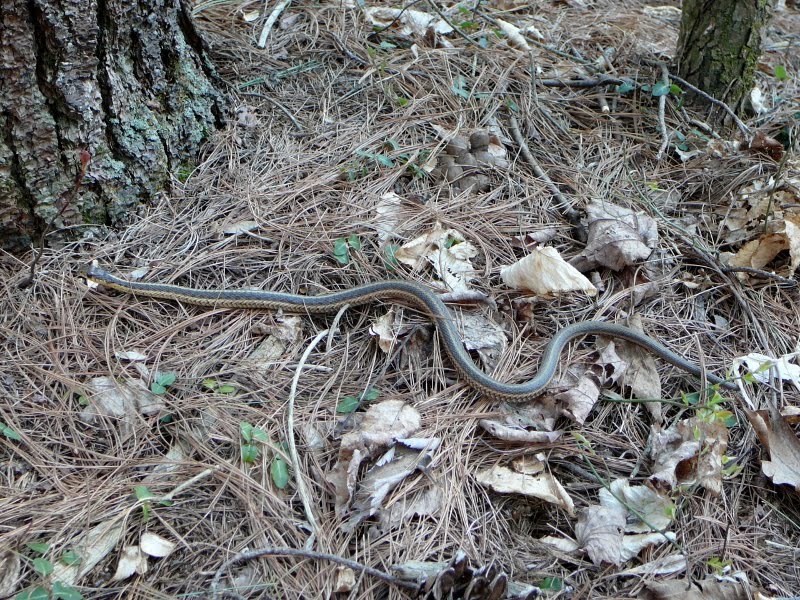
4.13.12 The list of this sunny morning's observations includes nine painted turtles sunning on a partially submerged log; wood frog egg clusters the size of softballs in a vernal pool; black flies out for blood - and the pictured Great-spurred violet. If you saw John's photo of the Northern White violet yesterday, observe the "beards" on the lateral petals. The pale violet-colored Great-spurred violet is characterized by the spur on the back of the flower and the fact that it is beardless. Also pictured is my first sighting of the season's Jack-in-the-Pulpit with leaves just unfurling and a Garter Snake out sunning itself near the base of a White pine tree.

Thursday, April 12, 2012


4-12
Northern White (?) Violets in flower today. Tiny wildlings are often spectacular close up. Note the bushy-eyebrowed insect on the leaf.
John

Sunday, April 8, 2012


4.08.12 We need rain!! This vernal pool is more like a puddle already, and the amphibians have barely laid their eggs. Spotted salamander eggs are encased in a thick layer of jelly which is firm enough to hold its shape out of water. They have a whitish-appearance in the water. The wood frog eggs don't have a jelly casing; the mass attaches to twigs and submerged vegetation. There were many such egg masses in this shrinking pool.

Saturday, April 7, 2012


4.07.12 Common Spicebush (Lindera benzoin) is in bloom in sunny, wet spots. The sweet-scented yellow blooms open before the leaves unfurl. This American hornbeam, aka musclewood or blue beech is showing off its "muscles" more than most.

4-7
Here a Cabbage White visits the Trout Lily.
John


4-7
Along the railroad track bike path in Dummerston and Brattleboro, Strawberry, Jack-in-the-Pulpit, Violets, Kidneyleaf Buttercup and Trout Lily were in bloom.
John

Friday, April 6, 2012


4.05.12 Spring beauty announces its presence with its sweet aroma and then I start hunting among the leaf litter in the rich soil of sunny spots. The seeds of these ephemerals have an eliasome, a fatty appendage, that attracts ants. The ant carries the seed off to its home, eats the eliasome and discards the seed, thus planting it and keeping it safe from other would-be predators.
The brown wands of the Ostrich fern are the fertile blade of the plant. They wait for spring winds to disperse their spores. Collectors of fiddleheads find them useful for spotting where the new fronds are coming up in spring.

Monday, April 2, 2012


4-2
Spring is creeping up the West River valley. Dutchman's Breeches are in flower a mile north of Brattleboro. Saxifrage is flowering up to the town line. Trillium is open almost that far north. Columbine flowers are ready to open, and Toothwort's first flowers wont be far behind.
John


4.02.12 Rocky outcrops with southern exposure are the locations of all of these early spring plants. The green swords of leeks are an early food crop for many animals (humans, too!). Some of these were chewed off, as if cut with dull scissors, about 1" high. Amidst some were last year's weathered seed pods, still containing a few shiny black seeds. The leaves disappear in late June, before the globe-shaped flower spike opens, making it difficult to associate the two. However, when crushed the aroma of both is strongly that of onion/garlic.
On the same outcrop, Hepatica nobilis, var.obtusa (Round-lobed hepatica) held up their blue, pink, or white clusters of blossoms on fragile hairy stems. The leaves provide the distinguishing characteristic, three rounded lobes.
Also among leeks, were some lacy-foliaged Dicentra cucullaria (Dutchman's breeches) - little white heart-shaped pendants strung on a succulent pink stem.
Another such outcrop gave rise to both clumps of Dutchman's breeches and Sanguinaria canadensis (Bloodroot), a member of the Poppy family.

Sunday, April 1, 2012

4.01.12 A young moose wandered through our property, crossed the East-West Road (fortunately, no traffic was coming), and disappeared into the woods. Sorry - it was too dark for photos. Those long legs can take them far in a short while. Keep watch!

(not an April Fool's Day joke!!)

Friday, March 30, 2012


3-30
This afternoon a Bumblebee visited my Andromeda bush. It was the first I'd seen this spring. And Gill-0'er-the-ground, Dandelions, and Bluets have started flowering in my lawn.
John

Sunday, March 25, 2012


3-25
Daphne, a garden cultivar gone wild, was flowering along Green Mountain Camp Road this morning.
John

Saturday, March 24, 2012


3-24
Mayflowers - which could more precisely be called Marchflowers this year - can be found flowering in warmer locations.
These were beside Camp Arden Road.
John

Monday, March 19, 2012


3.19.12 The summer-like temperatures and longer days of sunshine are providing energy for the emergence of many species. On a walk today, bunches of blue or white hepaticas were in bloom on a rocky hillside; wood frogs were chorusing in a beaver-constructed narrow pond; a Sallow moth, pictured here (probably the Jocose Sallow) was spotted despite its remarkable camouflage; and Eastern comma(the orange-colored photo) and Mourning cloak butterflies were darting about.

Sunday, March 18, 2012


3-18
Phoebes are back! I saw them along the West River this morning. By mid-afternoon they were in my yard.
As the afternoon warmed up, a lone Hepatica blossom opened.
One Palm Warbler was foraging with the local junco flock.
And a Mourning Cloak butterfly was wafted through on the day's mild breezes.
It was a taste of spring!
John

Wednesday, March 14, 2012


3.14.12 While looking for possible duck arrivals, this muskrat swam in circles, ever closer to the edge of the pond where I was standing. It appears to be using a tunnel in the side of the pond that was used previously by the river otter that has visited the area in other years. This is the first time I've observed muskrat activity in this small pond.

Tuesday, March 13, 2012

3-13
At dusk the male Woodcock were putting on fine performances in the fields around my neighborhood.
John

Monday, March 12, 2012


3-12
Yesterday there were Killdeer on the Retreat Meadows.
Today the earliest of the early. Colt's Foot and Chickweed were both in flower along sunny roadsides.
John

Sunday, March 11, 2012


3.11.12 Cedar waxwings make the rounds at this time of year, cleaning up neglected apples and other fruit. About a dozen of them turned their pale yellow breasts into the warm sun and dozed; the earth under the tree was littered with russet apple pumice and the air held the aroma of cider.
In the garden under the apple tree, kale that self-seeded last fall shows the beginnings of new growth.

Tuesday, February 28, 2012


2.27.12 Although there's little-to-no snow on southern exposures and in the valley, the north side of Black Mountain still has several inches of white, frozen precipitation the texture of firm styrofoam. Sturdy ice cleats were much-appreciated as I bushwhacked my way to the top over terrain that I rarely attempt. Just as I was thinking that I should be looking for mountain goat tracks, bobcat tracks appeared instead. Bobcat tracks are difficult to see on hard snow; their furry feet prevent clear toe imprints, and the margin of the track is blurred by their fur insulation.
At a much lower elevation, a flock of turkeys was out fluffing up leaf litter under hemlock and beech trees and chatting as they dined; I wondered if the bobcat had investigated them, too. There was too little snow to think I'd see any of its tracks there.

Friday, February 17, 2012


2.16.12 The temperature was in the upper 30's and old snow had softened to corn snow. I meandered through a mixed wood en route to an open field until I came to a stream. A coyote recently had chosen the same spot as I for crossing. Backtracking the animal, its gait was even, and its tracks indented the surface just enough to follow as it came from the upper reaches of the mountain. However, as it came to the open water, footprints imprinted much deeper as it powered off the edge to clear the 3-foot wide expanse by nearly two feet of margin.

Sunday, February 12, 2012


2.12.12 The River otter commutes between bodies of water via overland routes as well as through streams. The otter I've been tracking for several years bounds along, sliding on its stomach, both uphill and down. For the last 3 years, it has constructed a new den annually in the bank at the edge of a pond. Muddy tracks lead from the open edge of the pond to the 8-inch opening to its den. It leaves the den to use its latrine nearby. The slide pictured was made earlier this winter, but without new snow, it has remained a frozen record of its travels.