Welcome

To all those interested in the natural world. Please add your sightings.

In the woods we return to reason and faith-Emerson

Best-Lynn

Wednesday, November 9, 2011


11-9
In a nearby field, Golden Alexanders makes one last - seemingly out of season - attempt at flowering. I expect to find Alexanders flowering late spring and early summer. Finding one in November seems a bit incongruous ... but, there it is.
John

Tuesday, November 8, 2011


11-8
White Clematis (aka Virgin's Bower) unfurls its feathery seed plumes to the fall winds.
John

Monday, November 7, 2011


11-7
One of the hearty and ubiquitous Sulphur Butterflies warmed to the midday sun in my field today.
John

Sunday, November 6, 2011

11-6
I have two Yellow-bellied Sapsuckers, one juvenile and one female visiting my suet feeders.
For the last several years Sapsuckers have over-wintered in my neighborhood, although historically the northern extreme of their winter range was Massachusetts.
John

Thursday, November 3, 2011


11.03.11 In spite of recent wintery weather, these Ravenel's Stinkhorns seem to be continuing to develop at the base of a decaying maple tree. The pinkish round structure is the first above-ground appearance of this fungus from its mycelial tissue - "rootlets". The cap, on its spongy-looking white stalk pushes out of the volva; spores are dispersed through the white-ringed opening in the cap. Usually, the odor rouses my awareness to their presence before I see them; in today's cold temperature, that was not so.

Wednesday, November 2, 2011


11-2
As the snow melts, dandelions are opening; half a dozen brightened my lawn today.
John

Sunday, October 23, 2011


10.23.11 Raccoons often come to my garden and yard foraging for dropped fruit and whatever else they can find. These tracks were made last night, probably on their way to look for apples.

Now the leaves are falling, the nests of baldfaced hornets are easier to see. This one, about the size of a basketball, is about 30 feet off the ground. Foxes, raccoons, and skunks looking for larvae to eat will tear apart the nest if it's near the ground. Constructed at the end of a small branch in the top of a maple tree, this nest will be protected from those predators unless a severe wind knocks it down. Birds sometimes use the nest 'paper' in constructing their own nests in the spring.

Monday, October 17, 2011


10.17.11 It's that time of year: as I walked through woods populated with many robust red oak and beech in varying stages of vigor, the ground was littered with acorn caps and the prickly burs of beechnuts, many opened in their three-part symmetry. I was thoroughly scolded by a tail-shaking gray squirrel that skittered back and forth on a high branch of a white pine. A chipmunk peered from the hole in a dead beech where it was storing nuts. We observed each other for several unblinking minutes as it tried to sneak away to get on with business. As soon as my gaze shifted, the chipmunk was gone. This beech snag is host to Tinder polypore, (Fomes fomentarius) the gray hoof-like fungus and a number of other fungi, in addition to providing a storage chamber for this chipmunk.

Sunday, October 16, 2011


10.16.11 We've been learning about and looking for Woolly Hemlock Adelgids for a couple years because their alien origin leaves them in our environment without natural predators, thus they're free to multiply and spread and cause the eventual death of Hemlock trees. The Woolly Alder Aphid pictured here feeds, reproduces, and multiplies in much the same way as the Woolly Hemlock Adelgid; however, it doesn't get out of control because it has native predators that keep it in check. Like many other aphids, this aphid is tended by ants which benefit from the "honeydew" that they produce. The sap the aphids suck from the host is primarily sugars; to get enough protein for reproduction, the aphid consumes more sugar than they need, and honeydew is produced to get rid of this excess. The honeydew is what causes the black, sooty deposit on surfaces below the aphids.

Saturday, October 15, 2011


10.15.11 Sun has been in short supply lately, so a walk into the woods in sun was irresistible. Among the fallen leaves, I noted this mushroom with its margin rolled back, filled with rain water. The warty growths on the surface gave the appearance of a gem-studded urn. I've tentatively identified it as Scleroderma aurantium; if anyone can positively identify it, please let me know! Along a noisy, leaf-littered stream, the witch-hazel shrub is coming into bloom, just as its leaves are turning yellow and dropping. Hamamelis virginiana blossoms in the fall; it is unusual in that flower, fruit, and next year's leaf buds appear simultaneously on the branches.

Sunday, September 11, 2011


9-11
Closed or Bottle Gentian (G. andrewsii) is in flower along East-West Road.
John

Thursday, September 8, 2011


9-8
This paper wasps' nest has enveloped the end of the maple limb it hangs on. Still green maple leaves bisect its outer layer, providing a bit of unintentional camouflage.
John

Friday, September 2, 2011

9-1
Large groups of nighthawks were on the move this evening. Between 630 and 7:30 pm about 80 passed over my house.; thirty-five in one swarm.
John

Wednesday, August 24, 2011


8-24
Aphids suck the top of a milkweed dry as a Monarch caterpillar feeds lower down on the same plant.
John

Saturday, August 20, 2011


8-20
A 1 1/4 inch long female Dogday Harvestfly hangs atop a slender Silverod stem. Dogday harvestflies are a kind of Cicada. Their nymphs which live underground and feed on "root juices" take 3 years to mature. Adults live one season, just long enough to mate and lay eggs. The eggs are laid on the twigs of trees, but soon after the eggs hatch the larvae drop to the ground where they will burrow in and stay hidden down among the roots until they reach maturity.
John

Friday, August 19, 2011


8.19.11 Drama in the garden! A Braconid wasp injected her eggs into this Tomato Hornworm; the developed larvae spun these cocoons, attached all over the outside of the hornworm, from which they will pupate. Left alone, a Tomato Hornworm can eat its way through a lot of foliage and tomatoes in the course of its development.
The throat of the Willow Gentian in the flower bed was the hiding spot of the white goldenrod crab spider. When the moth visited the flower last night,'the spider grabbed the moth with its long front legs, injected a paralyzing poison and digestive enzymes into the moth. After the spider's enzymes have turned the insides of the insect into liquid, the spider sucks the prey dry until only the exoskeleton of the insect remains' according to Mary Holland in Naturally Curious.

Wednesday, August 17, 2011


8.17.11 Swampy areas are always enticing to plant hunters. Common Buttonbush, a shrub, may grow in 4 feet of water; today's specimen was growing in open water of unmeasured depth, accessible to me only by the zoom lens on my modest camera. The black, spatulate fungi, called Earth Tongues, were growing in the sphagnum moss at the margin of the swamp. Just a bit inland, this Earth Fan (Thelephora terrestris) was found in the undergrowth of trees.

Sunday, August 14, 2011


8-14
This morning's walk turned up one of the rushes - probably Juncus Canadensis - showing tow normal sized flower clusters above a third bizarrely galled and highly noticeable cluster!
John

Friday, August 12, 2011


8-12
Carrion Beetles prepare to bury a dead shrew. The beetles laboriously excavate under the carcass, letting it sink slowly into the earth. After it is fully covered the beetles will lay eggs on the shrew and when the eggs hatch the larvae will feed on the remains.
John

8-11
One tail feather from a Roughed Grouse graced the forest floor atop Prospect Hill today.
John

Monday, August 8, 2011


8.08.11 A Velvety Fairy Fan (fungus) and a Moonwort (fern) were two of a wide variety of growth this late summer morning in a damp woodland setting. The Bracted Plantain holds forth in a dry, sandy roadside.

8-8
Apparently last night's rain was an aphrodisiac for this pair of five inch long Leopard Slugs.
John

Saturday, August 6, 2011


8-6
A young gray fox paused to investigate a scent on his way through my yard last night.
John

Friday, August 5, 2011


8-5
The graceful curved blue stamens of Bluecurls prove it aptly named. These were found growing in a dusty gravel parking area.
John

Thursday, August 4, 2011


8-4
One adult raccoon and one youngster foraged through my yard last night.
John

8.04.11 Yesterday I received a call from a very excited grandson: I needed to be sure to come to his house because he had a special bird nest to show me. Indeed, it was well worth the trip and the anticipation. He has a styrofoam deer target propped up at the woods edge; he had been tossing objects to see if he could hit the target when a little bird came bursting out of the target! A chickadee has excavated a cavity in the neck of the "deer", directly underneath the muzzle. The opening is tear-drop shaped, about 1.5 inches in diameter; at the bottom of the 4 inch cavity lay 6 round, white eggs. After a quick survey of the situation, he decided he'd monitor progress from a respectful distance and let the little family have some peace.

Wednesday, August 3, 2011


8.03.11 Mushrooms provide a splash of color in the woods at this time of year. At the base of an oak tree, Chicken Mushroom (Laetiporus sulphureus) fairly glowed on a rocky mountainside today.

Tuesday, August 2, 2011


8-2
Today the less-than-fearsome looking Mad Dog Skullcap was flowering in a nearby swamp, and a glorious black butterfly - perhaps a Spicebush Swallowtail - nectared in my kitchen garden.
John

Monday, August 1, 2011


8-1
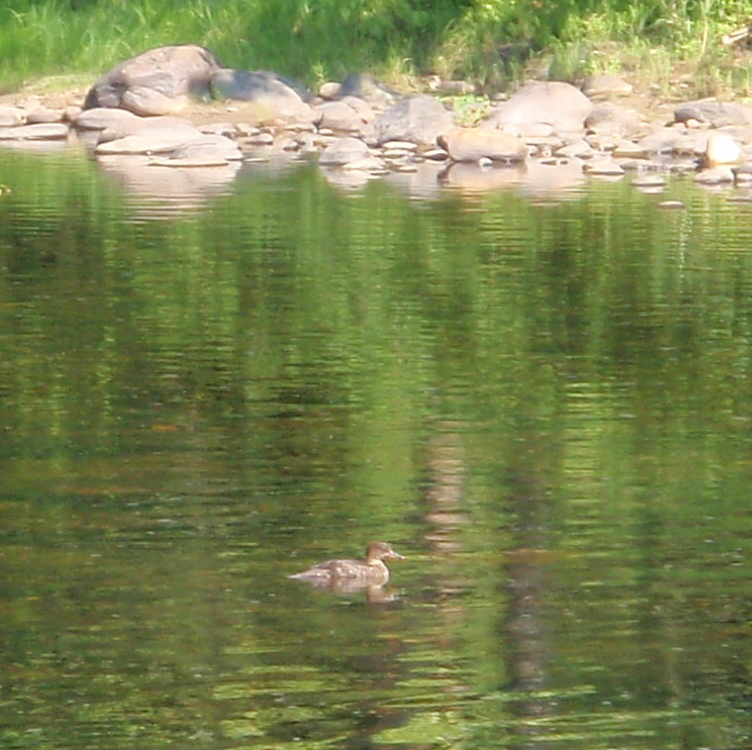
The shed nymphal skin of a Dogday Harvestfly - our local Cicada species - was hanging cellophane-like on a spruce tree in my yard, this morning, and this Merganser floated cooly down the West River, enjoying its riparian milieu before the human hordes descended.
John

Sunday, July 31, 2011


7-31
This Painted Turtle seemed somewhat disgruntled over being moved out of Roue 5 traffic, while nearby a Primrose Moth serenely waited out the day on one of its host plants: Evening Primrose.
John

Saturday, July 30, 2011


7-30
Today the brownish pea-like flower clusters of Groundnut draped riverside thickets. Along the roadside, clusters of tiny greenish flowers cupped by leaf-like bracts nestled in the leaf axils of Three-seeded Mercury.
John

Friday, July 29, 2011


7-29
Shining (AKA Dwarf) Sumac was in flower today. Apparently I was the second to learn of this development!
John

Thursday, July 28, 2011


7-28
In a roadside marsh, Hairy Willow-herb flashed its magenta faces today. As I appreciated one blossom a large beetle stayed busy and oblivious in a second.
John

Wednesday, July 27, 2011


7.27.11 Velvet-leaf's huge, bunny-ear-soft leaves drape gracefully, providing an umbrella over the buttercup-yellow blossom, but it's worth the effort to push them aside to view what's hiding.


7-27
A few Triphora (Three-bird Orchids) were unfolding their pallid wings today. Saprophytic Spotted Coralroots could also be found in flower.
In my kitchen garden this Snowberry Clearwing moth visited the phlox, seemingly obliious to my attempts at photography.
John